
The Toyota HSR platform
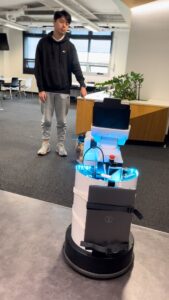
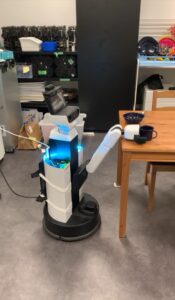
rUNSWeep’s earlier RoboCup@Home work used the Toyota HSR-B, known as Blinky. The team’s original account describes a domestic-robotics testbed in the Human Robot Interaction Lab, set up as a small apartment. The team was established in 2016 and first competed at RoboCup@Home in Nagoya in 2017.
How the 2024 software fitted together
The original system description grouped its ROS packages by capability:
- Perception and world modelling: object detection, person recognition and re-identification, gesture cues and a belief store representing the robot’s surroundings.
- Manipulation: interfaces to the HSR and services for grasping and other manipulation actions, with MoveIt and Grasp Pose Detection among the tools used.
- Navigation: mapping, navigation and person-following components, including GMapping and the ROS navigation stack.
- Planning and execution: state machines, action clients and servers, and a teleo-reactive planning prototype connecting task-level decisions with robot actions.
- Speech: audio streaming and Vosk-based speech recognition.
An external workstation mounted on the robot supplied additional computing capacity.
Tasks that exercised the system
The documented tasks included carrying luggage, cleaning a table, picking up an apple, serving breakfast and storing groceries. Some implementations were explicitly described as unchanged or untested after RoboCup 2024; they are records of the work at that time, not claims of current capability.
Read the 2024 team description paper (PDF), browse qualification records, or see the rUNSWeep project for the later transition towards Fourier GR-1.